Monday, December 7, 2009

(1400 - 1600) Renaissance Art

o Meaning Rebirth
o Revival of artistic interest in the classical world
o Individual expression
o Worldly experience
o Catholic dominant society
o Christian subject matter in many artworks
o Preoccupation with philosophy
o Humanism evolved
o Humans were the most important
o Artworks that glorified humans were popular
o Mathematical precision on architecture
o Time of great wealth and stability
o Education blossomed
o Ancient Greece and Rome influenced many artists
o Church commissioned artists to do work e.g. Michelangelo – Vatican
o Perfect forms e.g. Michelangelo’s Pieta and David
o Da Vinci’s Mona Lisa- first artwork to show real human expression
o Art – classic perfection
o Many of these artists came from Florence and it remained an important centre for the Renaissance into the 16th century eventually to be overtaken by Rome and Venice. Some of the ideas of the Italian Renaissance did spread to other parts of Europe, for example to the German artist Albrecht Durer of the 'Northern Renaissance'.


Raffaello Sanzio
"School of Athens"
1511 (high renaissance)
Fresco, 500 X 770

(1250) Gothic Art

o Mainly an architectural movement
o Detailed ornamentation most noticeably the pointed archways and elaborate rib vaulting.
o First developed in France
o Intended as a solution to the inadequacies of Romanesque architecture
o It allowed for cathedrals to be built with thinner walls and it became possible to introduce stained glass windows instead of traditional mosaic decorations.
o Some of the finest examples of the style include the cathedrals of Chartres, Reims and Amiens.
o Term was also used to describe sculpture and painting that demonstrated a greater degree of naturalism.


Veit Stoss
Sculpture
15th Century

(200 B.C) Roman Art

-Influenced by Greek art
-Rome- centre of civilization
-Romans – good soldiers, planners, administrators and engineers
-Love later naturalistic styles of Greek art
-Took Greek art, copied the ones that are to big to take:
Venus de Milo and Discabolus… copies of Greek art
-Writing is from roman times
They built:
Roads
Baths
Theaters
Aqueducts
Roman Architects
-Used Greek posts and lintel system and arch system
-Also used arches, vaults and domes
-Interior ad important as exterior
-Developed concrete
-Round building roofed with domes e.g. the Pantheon


Pompejanischer Maler um 60 v. Chr.
"Villa dei Misteri a Pompei"
60/50 BCE
Fresco, 162 cm

Wednesday, December 2, 2009

(400 B.C.) Greek Art: Archaic, Classical, Hellenistic

Archaic Greek Art:

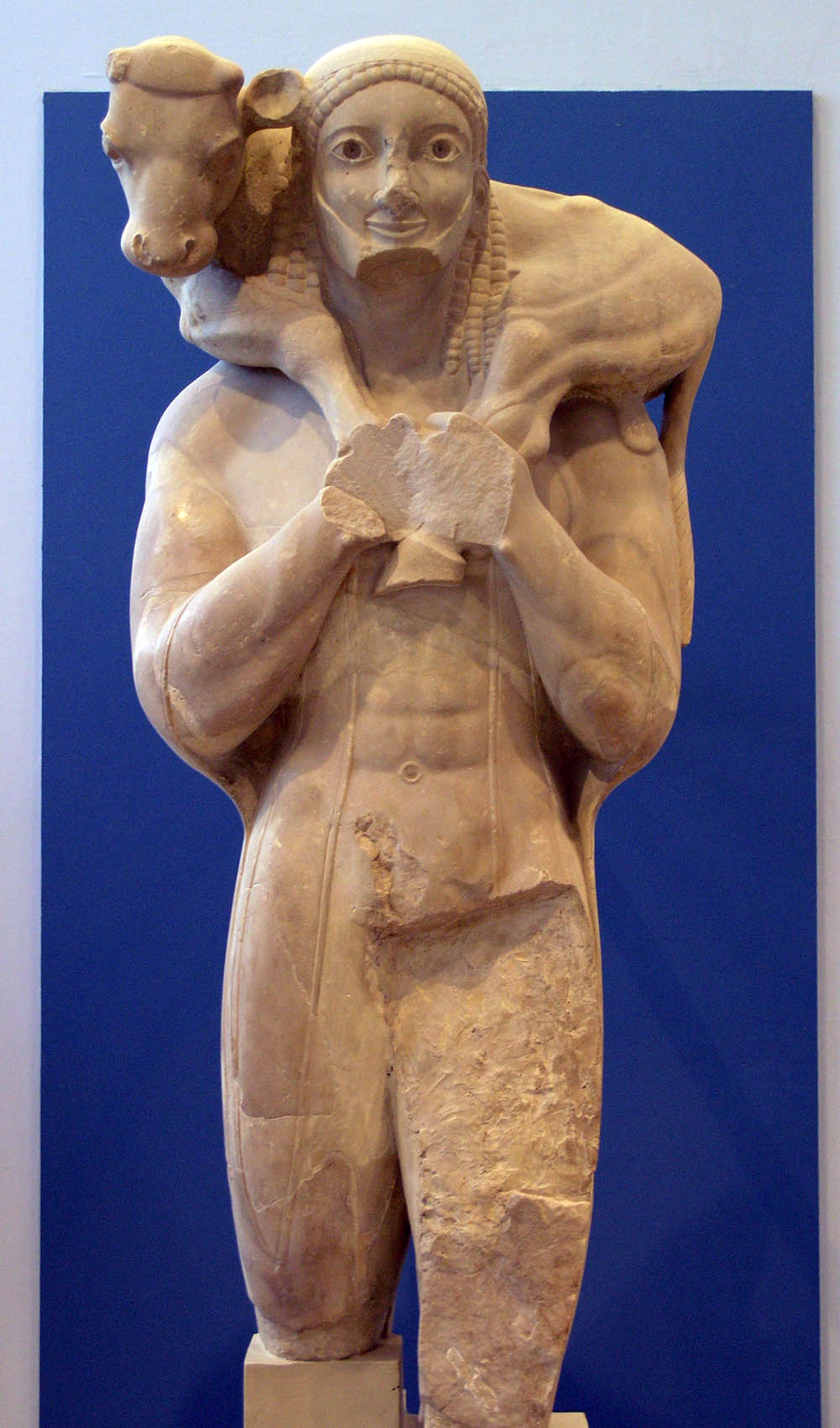
The Moschophoros (calf-bearer)
circa 570 BC
Athens


The sculpture itself is not as refined as later Greek artworks, and there is an element of naiivity about the artwork. This is prominent within the face, where the detail becomes much simpler.

Classical:

Began in 5th century B.C.
Ideal, perfect figures almost godlike figures
Beginning: only male nudes
Later: female nudes with draperies
More natural figures with turned heads
Sculpture: Natural form/In action or in rest/Marble/The sculptures were painted…lost due to weathering sculptors: figured out all body proportions
Sculptures of Gods and athletes
-Developed the idea of classicism
-Pursuit of perfection
-Think posh Everything is perfect
Greek buildings are mathematically faultless
Only stable wealthy societies can achieve classicism
Sense of optimism within society
Ancient Greece – highest form of “taste and style”
-Knowledge and intelligence


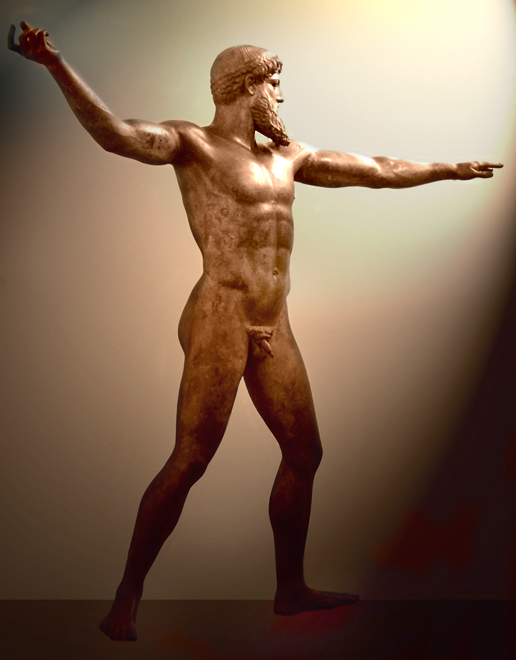
Poseidon (or Zeus) of Cape Artemision
c. 460 BC.
Athens


The figure is very refined and there is lots of detail that emphasizes the muscles of the figure. Its pose is very dramatic adding much more emotion to it than the Archaic sculptures.

Hellenistic:

Laocoön and his sons
200 BC.


The Hellenistic sculpture is very dramamtic, structured with many strong diagonals it makes the artwork much more dynamic. There is a great emphasis on the figures' facial features, therefore making the work more emotive than early sculptures.