Monday, December 7, 2009

(1400 - 1600) Renaissance Art

o Meaning Rebirth
o Revival of artistic interest in the classical world
o Individual expression
o Worldly experience
o Catholic dominant society
o Christian subject matter in many artworks
o Preoccupation with philosophy
o Humanism evolved
o Humans were the most important
o Artworks that glorified humans were popular
o Mathematical precision on architecture
o Time of great wealth and stability
o Education blossomed
o Ancient Greece and Rome influenced many artists
o Church commissioned artists to do work e.g. Michelangelo – Vatican
o Perfect forms e.g. Michelangelo’s Pieta and David
o Da Vinci’s Mona Lisa- first artwork to show real human expression
o Art – classic perfection
o Many of these artists came from Florence and it remained an important centre for the Renaissance into the 16th century eventually to be overtaken by Rome and Venice. Some of the ideas of the Italian Renaissance did spread to other parts of Europe, for example to the German artist Albrecht Durer of the 'Northern Renaissance'.


Raffaello Sanzio
"School of Athens"
1511 (high renaissance)
Fresco, 500 X 770

(1250) Gothic Art

o Mainly an architectural movement
o Detailed ornamentation most noticeably the pointed archways and elaborate rib vaulting.
o First developed in France
o Intended as a solution to the inadequacies of Romanesque architecture
o It allowed for cathedrals to be built with thinner walls and it became possible to introduce stained glass windows instead of traditional mosaic decorations.
o Some of the finest examples of the style include the cathedrals of Chartres, Reims and Amiens.
o Term was also used to describe sculpture and painting that demonstrated a greater degree of naturalism.


Veit Stoss
Sculpture
15th Century

(200 B.C) Roman Art

-Influenced by Greek art
-Rome- centre of civilization
-Romans – good soldiers, planners, administrators and engineers
-Love later naturalistic styles of Greek art
-Took Greek art, copied the ones that are to big to take:
Venus de Milo and Discabolus… copies of Greek art
-Writing is from roman times
They built:
Roads
Baths
Theaters
Aqueducts
Roman Architects
-Used Greek posts and lintel system and arch system
-Also used arches, vaults and domes
-Interior ad important as exterior
-Developed concrete
-Round building roofed with domes e.g. the Pantheon


Pompejanischer Maler um 60 v. Chr.
"Villa dei Misteri a Pompei"
60/50 BCE
Fresco, 162 cm

Wednesday, December 2, 2009

(400 B.C.) Greek Art: Archaic, Classical, Hellenistic

Archaic Greek Art:

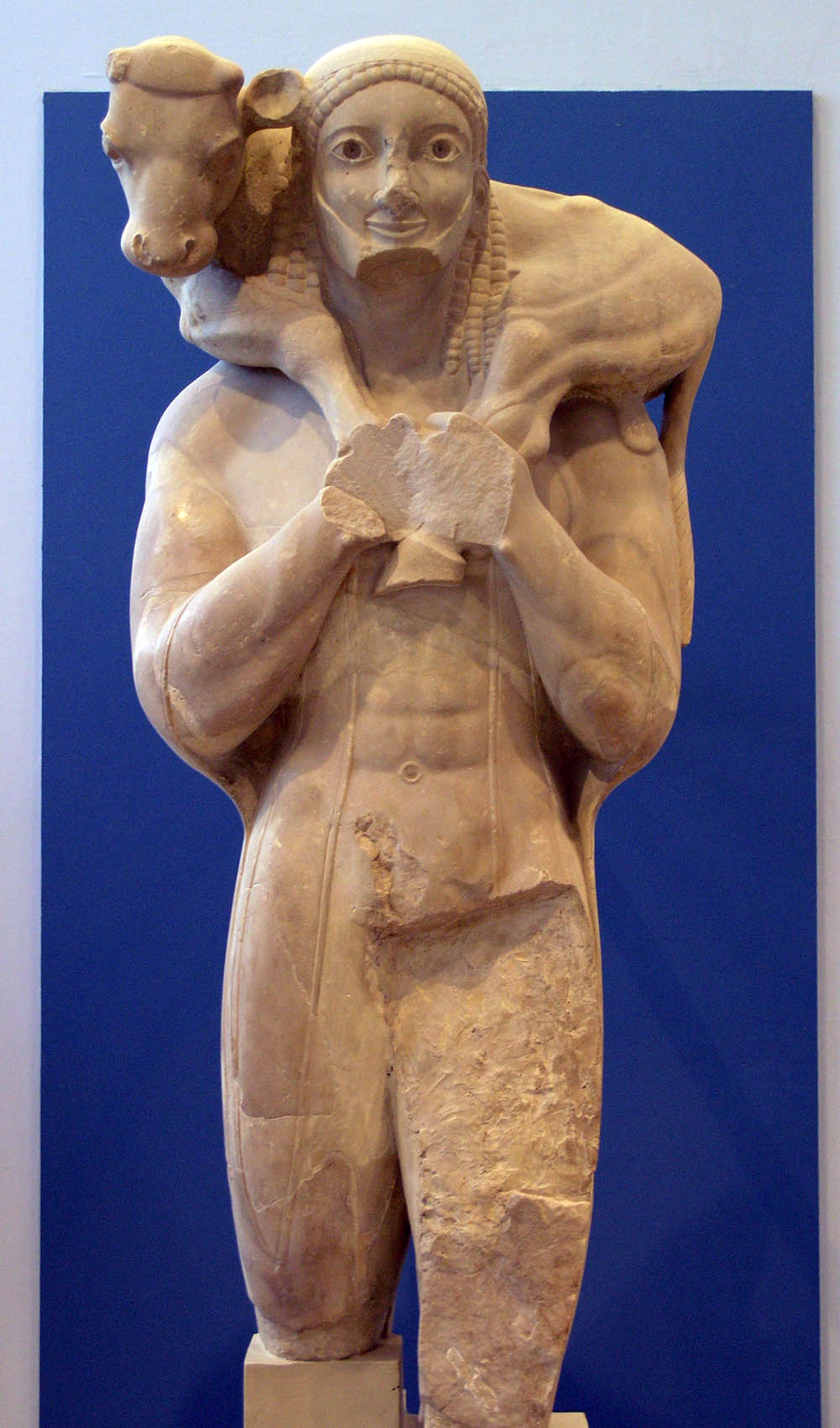
The Moschophoros (calf-bearer)
circa 570 BC
Athens


The sculpture itself is not as refined as later Greek artworks, and there is an element of naiivity about the artwork. This is prominent within the face, where the detail becomes much simpler.

Classical:

Began in 5th century B.C.
Ideal, perfect figures almost godlike figures
Beginning: only male nudes
Later: female nudes with draperies
More natural figures with turned heads
Sculpture: Natural form/In action or in rest/Marble/The sculptures were painted…lost due to weathering sculptors: figured out all body proportions
Sculptures of Gods and athletes
-Developed the idea of classicism
-Pursuit of perfection
-Think posh Everything is perfect
Greek buildings are mathematically faultless
Only stable wealthy societies can achieve classicism
Sense of optimism within society
Ancient Greece – highest form of “taste and style”
-Knowledge and intelligence


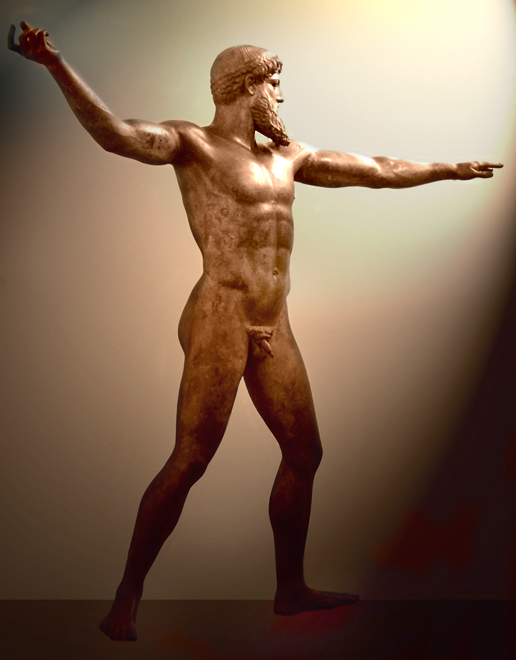
Poseidon (or Zeus) of Cape Artemision
c. 460 BC.
Athens


The figure is very refined and there is lots of detail that emphasizes the muscles of the figure. Its pose is very dramatic adding much more emotion to it than the Archaic sculptures.

Hellenistic:

Laocoön and his sons
200 BC.


The Hellenistic sculpture is very dramamtic, structured with many strong diagonals it makes the artwork much more dynamic. There is a great emphasis on the figures' facial features, therefore making the work more emotive than early sculptures.

Monday, November 30, 2009

Theory: (1600) Baroque, (1700) Rococo, (1750) Neo Classicism, (1800) Romanticism

(1600) Baroque:
o Is less complex
o More realistic and more emotionally affecting than Mannerism.
o This movement was encouraged by the Catholic Church, the most important patron of the arts at that time, as a return to tradition and spirituality.
o One of the great periods of art history
o Caravaggio, Annibale Carracci, and Gianlorenzo Bernini developed Baroque Art, among others. This was also the age of Rubens, Rembrandt, Velбzquez, and Vermeer. Moving away from classic idealism into realism
o Roman Catholic church was highly influential during this time
o Incorporating everyday life into art
o Influenced by religion, society and politics
o Chiaroscuro main characteristic associated with Baroque
o Characteristics of painting :-Movement Energy Chiaroscuro Dramatic figures Intricate detail Interesting textures Blurred edges Feeling of Infinite space


"Supper at Emmaus"
Carravaggio

oil on canvas, 54 X 76
1600-01


(1700) Rococo:
o His style consisted of delicate colours and gentle forms painted within a frivolous subject matter. .
o These works mirrored the frolicsome, artificial and ornamented decadence of the French aristocracy of the time.

o Tended towards lightness, elegance, delicacy and decorative charm
o Naturalistic detail
o When you think rococo think pretty and fancy… lace and charm
o Gave way to neoclassicism
o Rococo was the reaction against the ponderous
and formal atmosphere of baroque

o Referred to as the “AGE OF ENLIGHTENMENT”
o INDUSTRIAL REVOLUTION:
Throughout the 18th century in France, a new wealthy and influential middle-class was beginning to rise, even though the royalty and nobility continued to be patrons of the arts.
o Upon the death of Louis XIV and the abandonment of Versailles, the Paris high society became the purveyors of style.
o This style, primarily used in interior decoration, came to be called Rococo.
o The term Rococo was derived from the French word "rocaille", which means pebbles and refers to the stones and shells use to decorate the interiors of caves.
o Shell forms became the principal motif in Rococo.

o In the society women competed for the best and most elaborate decorations for their houses. Hence the Rococo style was highly dominated by the feminine taste and influence.
o Boucher won fame with his sensuous and light-hearted mythological paintings and landscapes.
o He executed important works for both the Queen of France and Mme. de Pompadour, Louis XV's mistress, who was considered the most powerful woman in France at the time.
o Boucher was Mme. de Pompadour's favourite artist and was commissioned by her for numerous paintings and decorations.
o Boucher also became the principal designer for the royal porcelain factory and the director of the Goblins tapestry factory.
o Characterized by elegant and refined yet playful subject matters, Boucher's style became the epitome of the court of Louis XV.


"Toilette de Venus"
François Boucher
108 X 85
1751


(1750) Neo Classicism:
o A nineteenth century French art style and movement that originated as a reaction to the Baroque.
o It sought to revive the ideals of ancient Greek and Roman art.
o Neoclassic artists used classical forms to express their ideas
about courage, sacrifice, and love of country.
o Jacques-Louis David and Antonio Canova are examples of neo-classicists.


"The Oath of the Horatii"
Jacques-Louis David
oil on canvas, 329.8 X 424.8
1784/85


(1800) Romantacism:

"Saturn Devouring his Son"
Francisco de Goya

oil on canvas, 146 X 83
1819-1823


Thursday, October 29, 2009

Still thinking...

My artwork is almost definitely going to resemble a post-modern artwork. My own style doesn't suit earlier styles of art- of course I could however take techniques from other styles, but that idea hasn't exactly appealed or worked for me yet. Soooo... I'm semi a quarter of the way there... Awesome right? Another thing I'm next to sure about is that my artwork is going to be metaphorical; there will be somethin that symbolises another thing. Whether what it symbolises is somewhat ambiguous, I'm not sure yet, and so comes the onslaught of choices... I have a choice in the subject matter whether it is going to be personal and meaningful, or just simply representing my interests. I think the subject matter is going to be the easy part though. With so many ways I can create an artwork I am stuck on how I am going to go about it. I could go digital, charcoal, collage, or even working with found materials.
Lemme think... I am comfortable with digital, butttt I don't wanna be usin just simply images from the internet like I've done with previous artworks. Again this is where Jessica Honeywill's artwork comes into mind...
I'm not going to do an image purely with charcoal though. If I used charcoal it would be with something else (like in a collage).
Collage and found materials... I can't really evaluate that one, cause there's too much I CAN do.

Tuesday, October 20, 2009

Body of Work Brainstorming

Thinking up ideas on my BOW...
So I'm not sure what the subject matter is going to be yet, except I'd like it to be personal. The media I'm goin to use? I can charcoal draw, use digital media, collage, paint, but I think ultimately my artworks are gonna end up as mixed medias- that way I'm not focusin on one area of practical study, but rather a whole wide range of areas. I might want to make my work expressionistic (not sure) but like I wanna express emotion within it, not sure to what extent however.
I've also thought of maybe approaching it in a simple way. On visiting art express earlier this year, one artwork in particular was stuck with me; "Two (II)" by Jessica Jade Honeywill.


Her artwork in the simplest way holds so much meaning and emotion to it, and in that way it draws the audience right in and captures them. This would be a response I'd love to achieve!!! = ]

Monday, October 19, 2009

Yr 12 HSC Begins : (

Hey, so this is my first blog, nd yea I need to do this cause Miss Higgins told me to but its alright. Nyways um not sure wat I'm supposed to be sayin but I guess I can talk bout Gerard criticising my Internet linguo... It's prtty annoyin actually I think it's perfectly readable nd understandable! Plus FYI it looks fine : P
Yer but he noes I'm kiddin... Kinda.
But I'm supposed to be talkin bout art so gimme a sec nd I'll start.
Yr 12 HSC Art... Wow it's prtty scary but I think I can handle it. Gotta start buildin up some ideas for my majors... OH! Nd I need to remember to write in my VAPD otherwise I'm gonna gets in twouble
: (
Nyways gud luck to every1 ; )